

Thick Client Penetration Testing

When client-side trust becomes risk.

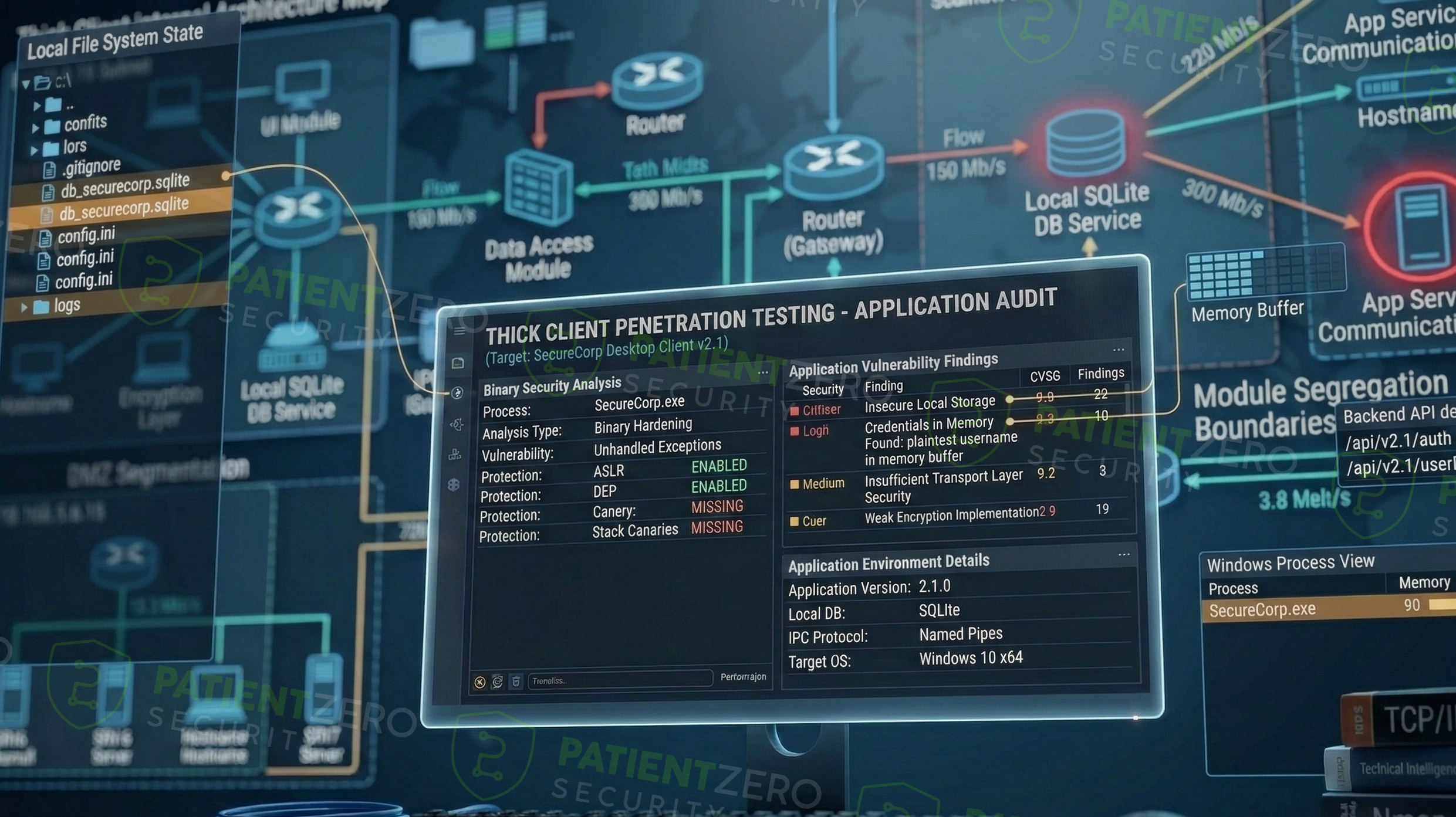
Thick Client Penetration Testing evaluates the security of desktop applications that communicate with backend services, APIs, or databases.
Aligned with PTES & NIST
|Traffic Manipulation|Binary Analysis
Thick client security analysis
Service description

What Thick Client Penetration Testing covers

Comprehensive analysis of client-side controls and backend interactions.

Thick Client Penetration Testing evaluates the security of desktop applications that communicate with backend services, APIs, or databases, where critical logic and trust decisions are often enforced on the client side. The service focuses on identifying whether client-side controls can be bypassed or manipulated to gain unauthorized access to backend systems or sensitive data.

Testing follows a manual, attacker-driven approach aligned with PTES and NIST SP 800-115, combining binary analysis, traffic inspection, and request manipulation. Tools such as x64dbg, dnSpy, Wireshark, and Burp Suite are used alongside manual techniques to analyze application logic, intercept client-server communication, and validate whether backend authorization is properly enforced independent of the client.

The assessment primarily reports individual client-side and client–server vulnerabilities, while also evaluating whether these issues can be chained to achieve higher-impact outcomes such as backend compromise or unauthorized data access. All findings are validated through controlled exploitation to support effective remediation prioritization.

Flowchart

Our thick client penetration testing process

From binary analysis to backend exploitation.

Engagement stages
Validating risk through binary reverse engineering, client-side control bypass, and traffic manipulation to prove realistic attack paths.
Step 01
Application Scope & Architecture Review
We work with your team to define test objectives, map application components, and understand how the thick client interacts with backend services and data stores.
Step 02
Client Binary & Resource Analysis
We perform static analysis of executable files, configuration resources, and embedded secrets to uncover weaknesses before the application is even running.
Step 03
Client–Server Traffic Inspection
We intercept, review, and baseline client–server traffic to identify unencrypted data, weak protocols, and abnormal or inconsistent communication flows.
Step 04
Client-Side Logic & Control Bypass
We analyze local validation, business rules, and trust boundaries to find ways to bypass client-side checks and force the application into unintended or insecure states.
Step 05
Request Manipulation & Abuse
We modify and replay captured requests to test how the backend responds to tampered parameters, sequences, and message patterns originating from the thick client.
Step 06
Backend Authorization Validation
We verify whether backend services correctly enforce authentication and authorization decisions even when the client application is modified or misbehaves.
Step 07
Exploit Validation & Reporting
We safely validate exploit chains end-to-end, document business impact, and prepare clear remediation guidance your engineering teams can act on.
Deliverables

What you take away

Actionable results for engineering and development teams.

Detailed vulnerability report with severity rankingExecutive summary and technical findings mapped to risk levels.
Proof-of-exploitation for validated issuesScreenshots and evidence for each confirmed vulnerability.
Clear explanation of business and operational impactRealistic attack paths and what a successful compromise would mean.
Actionable remediation guidance for developersSpecific code-level fixes and architectural recommendations.
Optional Technical Walkthrough with Engineering teamsSession to review findings, answer questions, and align on remediation.
Attack Chain VisualizationDiagrams showing how client-side flaws lead to backend compromise.

Ready to secure your applications?

Every engagement includes a formal report and optional live readout call.