

Defense Evasion Assessment

Testing what defenses fail to see

Defense Evasion Assessment validates how effectively your endpoint and detection controls identify and surface malicious execution techniques, using controlled custom payloads and realistic attacker tradecraft.
EDR & telemetry focused
|Custom payload execution|Detection engineering insight
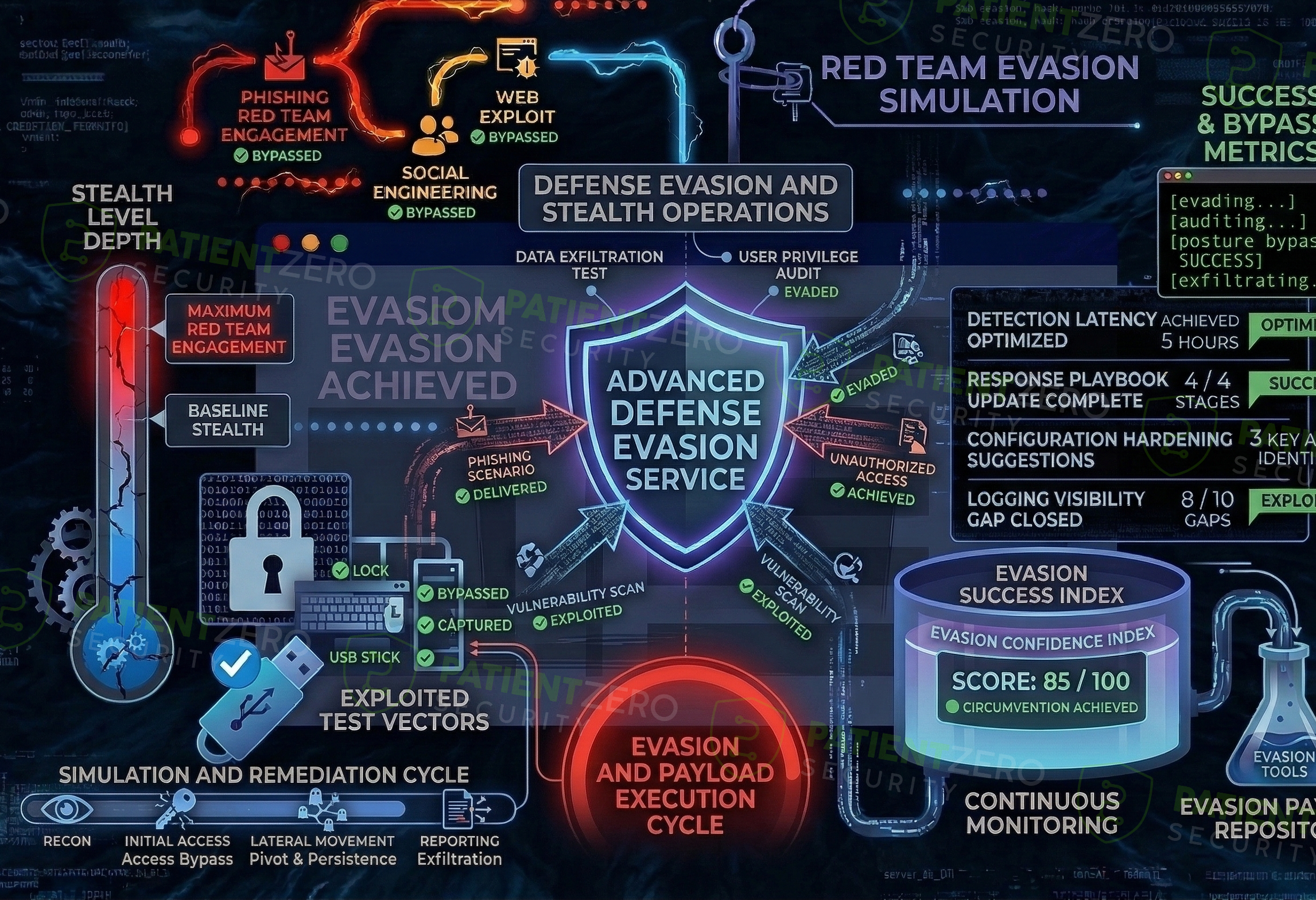
Defense Evasion Assessment Dashboard
Service description

What Defense Evasion Assessment covers

Detection-focused assessments that validate how well your environment surfaces and responds to malicious execution techniques.

Defense Evasion Assessment evaluates the effectiveness of endpoint detection and response (EDR), behavioural monitoring, and supporting security telemetry by testing how reliably they detect malicious execution activity. The engagement focuses on detection capability, not long-term persistence or full compromise.

The assessment combines custom payload and tooling development with controlled execution of common attacker techniques to simulate realistic defence evasion in a safe and repeatable manner. Activity is carefully designed to reflect how adversaries commonly bypass controls while remaining within an agreed and tightly governed scope.

This service is ideal for organisations looking to validate EDR coverage, improve alert fidelity, and mature detection engineering by turning simulated attacker activity into concrete, actionable improvement opportunities.

Flowchart

How a defense evasion engagement runs

From defining detection objectives through to summarising coverage and improvement areas.

Engagement stages
Structured execution testing aligned to realistic attacker techniques.
Step 01
Scope & Detection Objectives
Defining in-scope endpoints, environments, and specific detection objectives so that testing aligns with your monitoring priorities.
Step 02
Technique & Payload Design
Designing controlled payloads and technique variations that mirror common attacker execution and evasion patterns.
Step 03
Controlled Execution Testing
Executing techniques in a governed manner across agreed hosts or environments while carefully tracking activity.
Step 04
Telemetry & Alert Observation
Reviewing EDR events, alerts, and supporting telemetry to understand how activity surfaced in your monitoring stack.
Step 05
Detection Gap Identification
Comparing expected versus observed detection to identify blind spots, weak coverage, and noisy or missing alerts.
Step 06
Results & Improvement Mapping
Summarising overall detection effectiveness and mapping results to concrete improvements in rules, telemetry, and processes.
Step 07
Reporting & Debrief
Delivering a clear report and walkthrough session to align stakeholders on findings, trade-offs, and next steps.
Deliverables

What you take away

Concrete insight into EDR effectiveness, detection gaps, and how to strengthen your monitoring coverage.

Detection Effectiveness ReportA structured report summarising techniques tested, execution outcomes, and how effectively EDR and related telemetry surfaced malicious activity.
Documented Evasion TechniquesClear documentation of defence evasion techniques exercised, including configuration assumptions and any notable tool or behaviour-specific observations.
Detection Gaps & Visibility Blind SpotsIdentification of where telemetry was missing, insufficient, or not effectively correlated to surface meaningful security signals.
Recommendations & Tuning GuidancePractical recommendations to improve detection rules, alert fidelity, monitoring configuration, and overall detection engineering maturity.

Ready to test your detection coverage against real techniques?

Schedule a consultation to define detection objectives, agree safe execution constraints, and plan a defense evasion assessment tailored to your tooling and environment.