

Assumed Breach Scenario

Security beyond compromise

Assumed Breach Scenario evaluates your environment after compromise, starting from predefined internal access to understand how far an attacker can move, escalate, and impact the business.
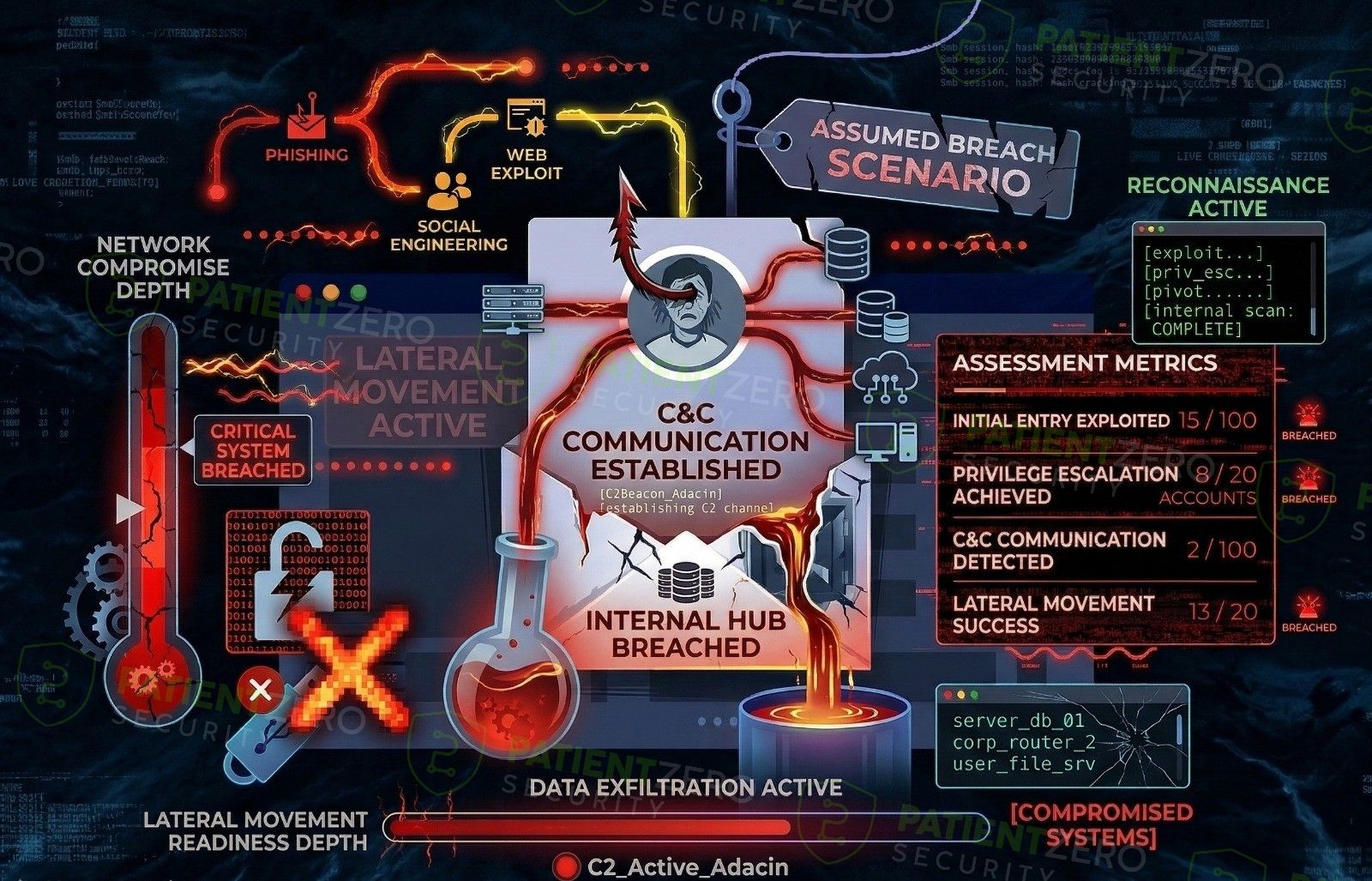
Post-compromise focused
|Internal attack paths|Zero Trust validation
Assumed Breach Scenario Dashboard
Service description

What Assumed Breach Scenario covers

Post-compromise assessments that focus on internal movement, containment, and impact rather than perimeter defence.

Assumed Breach Scenario evaluates an organisation’s security posture after an initial compromise has already occurred. The engagement begins with predefined internal access, such as a standard user account or compromised workstation, and focuses on how effectively internal controls limit attacker movement, privilege escalation, and overall impact.

This service is particularly useful for assessing post-compromise security, including exposure to internal threats, compromised credentials, and insider-risk scenarios. Rather than testing perimeter defences, the assessment evaluates how well internal security controls, identity protections, segmentation, and monitoring prevent an attacker from expanding access within the environment.

The primary objective is to understand the blast radius of a single compromised user or system, and to determine whether attackers can escalate privileges, move laterally, or access high-value assets without being detected or contained.

Flowchart

How an assumed breach engagement runs

From starting conditions through to impact and blast radius analysis.

Engagement stages
Structured internal attack simulation based on predefined access.
Step 01
Assumed Initial Access
Starting from agreed internal access such as a user account, workstation, or internal segment to mirror realistic compromise conditions.
Step 02
Internal Enumeration
Discovering accounts, systems, and trust relationships to understand internal exposure and potential attack paths.
Step 03
Privilege Escalation Attempts
Attempting to escalate privileges using misconfigurations, credential reuse, and weak controls while observing detection and blocking.
Step 04
Lateral Movement & Expansion
Moving between systems and segments to reach higher-value assets, testing internal segmentation and monitoring coverage.
Step 05
Payload Execution & C2
Running payloads and command-and-control simulations to understand how ongoing internal activity is surfaced and contained.
Step 06
Actions on Objectives
Pursuing agreed internal objectives such as data access or system control to demonstrate realistic post-compromise impact.
Step 07
Impact & Blast Radius Review
Reviewing how far the attack could spread, what data was reachable, and how security controls performed across the engagement.
Deliverables

What you take away

Clear visibility into post-compromise risk, internal attack paths, and containment effectiveness.

Assumed Breach ReportA detailed report covering scope, assumed access conditions, internal attack paths, privilege escalation analysis, and access to high-value systems or data where achievable.
Internal Attack Path & Segmentation AnalysisInsight into lateral movement opportunities, segmentation gaps, and how far an attacker can realistically spread from the initial foothold.
Detection, Response & Containment ObservationsEvaluation of how monitoring, incident response, and containment processes performed during the simulated internal attack.
Risk-Ranked Findings & Debrief SessionRisk-ranked remediation recommendations and a post-engagement walkthrough session to align stakeholders on findings and next steps.

Ready to validate your post-compromise resilience?

Schedule a consultation to define assumed access conditions, discuss scope, and plan an internal attack simulation tailored to your environment.