

AI / LLM Penetration Testing

Intelligence, secured from within.

Assess and secure your Large Language Models and generative AI systems inside-out against prompt injection, testing, and data leakage.
Aligned with OWASP Top 10 for LLMs
|Adversarial exploitation focused|Model and application security
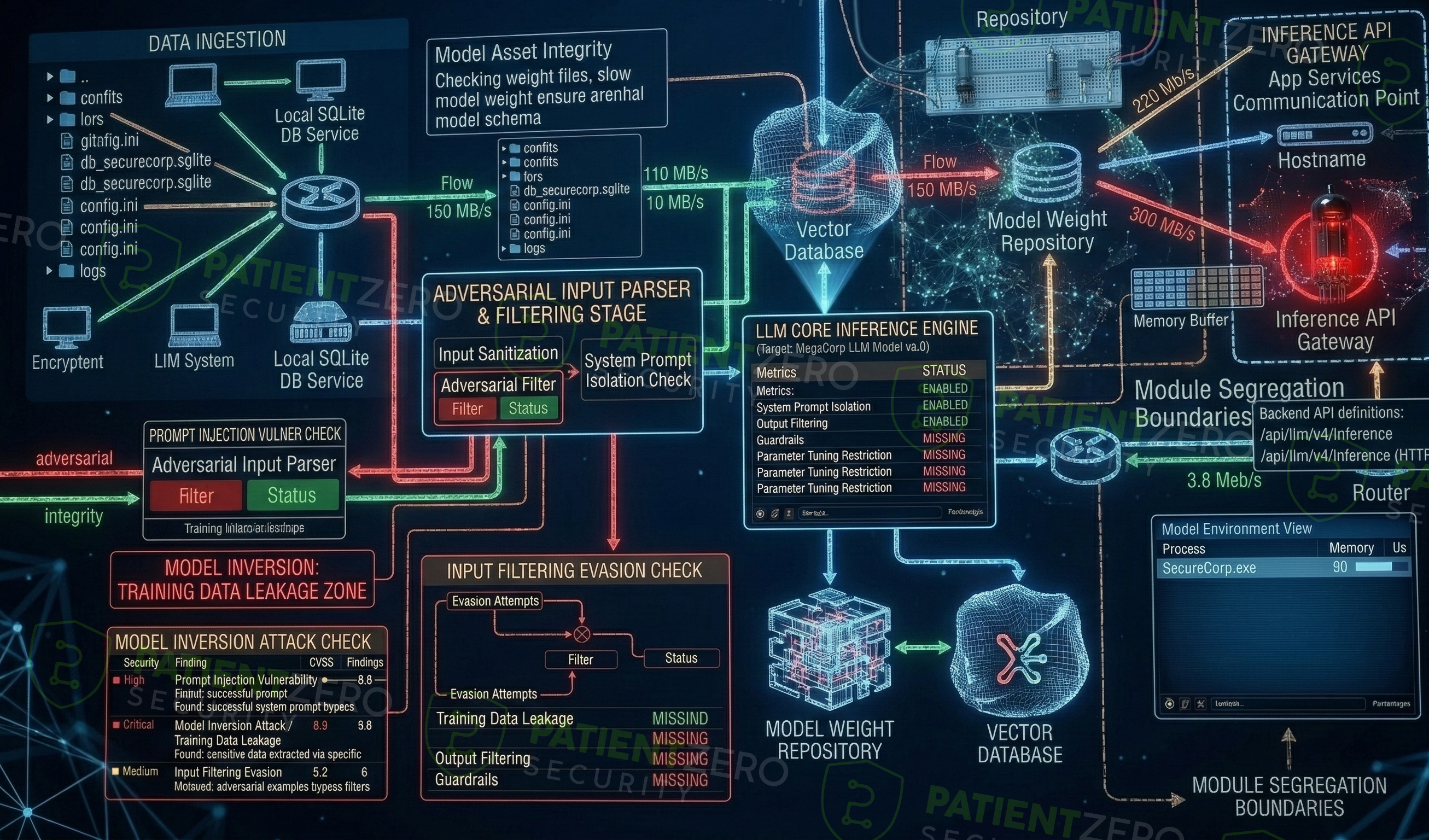
AI / LLM Penetration Testing Visual
Service description

What AI / LLM Penetration Testing covers

Identify vulnerabilities in generative AI endpoints, models, and retrieval-augmented generation (RAG) environments.

Our AI / LLM Penetration Testing assesses both the application layer and the underlying machine learning logic. We simulate an attacker attempting to bypass your LLM's guardrails, manipulate its decision-making, and extract unauthorized data. If your application relies on Retrieval-Augmented Generation (RAG) to process sensitive domain knowledge, we test whether an attacker could alter the database or trick the model into revealing internal records.

Testing is aligned with the OWASP Top 10 for LLM Applications to ensure systematic coverage of emerging AI vulnerabilities. We go beyond generic prompt injection checklists to test deeply integrated features like tool calling, function execution, and recursive prompt behavior. If your model controls actions (like sending emails or modifying databases), we attempt to hijack that execution flow.

While standard vulnerability scanners fail to understand the contextual logic of LLM interactions, our manual approach leverages both manual crafting and automated adversarial testing. We aim to answer practical questions: Can a user trick the model into ignoring its instructions? Can they extract the system prompt? Or cause a denial of service by overwhelming the context window?

All findings are documented in clear, reproducible reporting designed for both executive review and engineering remediation.

Flowchart

Our AI / LLM penetration testing process

From initial access to the models to assessing the foundational code.

Engagement stages
Communication is continuous throughout the typical 3-4 week testing process.
Step 01
LLM Architecture & Model Hierarchy Mapping
We map models, endpoints, APIs, third-party integrations, and data sources that the application interacts with to determine the true attack surface.
Step 02
Prompt Injection & Jailbreak Simulation
We craft complex adversarial prompts and system instructions to bypass input filters, manipulation commands, and escape sandboxes.
Step 03
Extraction Resistance & Context Manipulation
We test if the model can be guided into leaking its system instructions, internal logic, or previously processed data from its context history.
Step 04
Sensitive Data & Internal Leakage Testing
We probe the model for sensitive PII or PHI across various prompt structures to assess its response handling and redaction mechanisms.
Step 05
RAG & Vector Store Poisoning Validation
We attempt to poison the retrieval-augmented generation databases, altering documents and data to influence the model's trusted responses.
Step 06
Tool Invocation & Agent Abuse Simulation
We assess the security controls on any tools, functions, or APIs that the LLM has access to, simulating hijacking and unauthorized execution.
Step 07
Model Abuse & Denial of Service Testing
We perform resource exhaustion tests against the model endpoints, analyzing context windows limits and token processing overload.
Step 08
Multi-Step Prompt Chaining & Exploit Paths
We chain together multiple bypassed restrictions to demonstrate business impact and system exploitation.
Step 09
Remediation & Hardening Recommendations
We provide actionable guidelines to fix vulnerabilities, including input filtering, boundary reinforcement, and strict schema validation.
Deliverables

What you take away

Actionable deliverables to guide remediation and understand systemic risk.

Detailed AI / LLM penetration testing reportClear severity ranking with CVSS scores for every vulnerability found, from high to info.
Proof-of-exploitation for attack scenariosDetailed steps and payloads allowing your developers to reproduce and validate the exploit chain.
Contextualization of impactA summary aligning the technical risk and impact to your organization's environment and business logic.
Risk mapping aligned to OWASPDetailed security posture against standard ML frameworks and industry standards.
Actionable remediation guidanceStep-by-step documentation detailing how to apply guardrails, filters, logic, tracking, and architectural changes.
Option to re-test vulnerabilitiesAvailable validation testing to verify fixes and ensure no new risks from remediation attempts.

Ready to secure your AI systems?

Every engagement includes a formal report and optional live readout call.